Showing posts with label teachers. Show all posts

Thursday, April 28, 2011

Why Connecticut's Schools are Lagging

I'm re-posting from an excellent Westport Patch article going through the litany of why CT fares so much worse than residents believe.  You can find it here: Why Connecticut Schools are Lagging.

To the extent readers don't think that CT residents are delusional on this point, I point to our town budget hearing of two weeks ago. The President of the local PTO stood up and said she couldn't believe her luck in moving to town, because the schools just keep getting better and better. Even those opposed to the budget kept their comments focused on the need to cut spending and keep taxes down while maintaining the excellence of the schools. No one ever says out loud in public that the schools are not all they are cracked up to be.

The Westport Patch article is spot-on. My only complaint is that it misses two of the most critical reasons as to why our CT schools lag.  The first -- horrible curriculum foisted upon us through the State DOE through vague state standards and state consultants that actually recommended poor curriculum to local districts. Any parent that has ever complained about the use of Everyday Math has heard the same justification that I have: it meets the State Standards. The State actually insists that we use this wretched curriculum, despite its short-comings, despite the parents' opposition to it and despite the rather weak research background of the program. The same goes for the  whole language and balanced literacy that has largely replaced phonics and grammar.

The second reason that CT will continue to fail is the poor quality of our schools of education. Add to this, the difficulty teachers have crossing from state borders. A certified teacher from another state (with higher standards) must jump through hoops and incur expenses to teach in CT. Because we have a very small state, we should not be slamming our doors at the border to good teachers wishing to move in. The inability to easily move between states means that CT is overly reliant upon teachers graduating from our own in-state teacher colleges. That would be okay if those colleges were producing top-notch teachers, but that is simply not the case.

Anyway, from the Westport Patch, Nathan Allen says this about the Achievement Gap:
The fact is, poor and minority students are better educated in Florida and Texas than in Connecticut. Connecticut’s poor and Hispanic students are outscored by Moldova, and Connecticut’s black students barely beat Egyptian and Palestinian student scores. Our poor and minority students can’t outscore students from developing nations with 1/20th the per-capita income.
And on our best students:
Internationally, Connecticut’s highest scoring 8th graders score behind Slovenia, Estonia, and Poland in math on the Programme for International Student Assessment (PISA). And these are our best students. 

Friday, April 22, 2011

The Blame Game -- from the School Institution Point of View

The current issue of The Nation contains this: Teachers are not the Enemy.

I wanted very much to embrace the premise of this article. As a proud lefty, I am not interested in bashing unions for the fun of it. I was really hoping to find a spirited defense of teachers and unions that would point a way forward toward school improvement. For the past decade, the efforts to improve the schools came mostly from the right. The left has tended to defend the status quo, while requesting ever larger quantities of money. It has been disheartening to those of us that think we need to change the way we are doing things, but would like to believe that the teacher union should have a seat at the table and be a part of the process.

So I had high hopes for the article in the Nation. We need the left to engage in the debate on how to make the changes we need to make without dismantling the good with the bad. Unfortunately, I was once again disappointed.

You will not find an acknowledgment anywhere in the Nation's article that the current system sucks for a whole lot of kids and families, that for even our best and brightest (and best funded) schools are not keeping pace internationally with their peers, that those in our urban schools are dropping out in shockingly high numbers and those that graduate are woefully unprepared for college level work.

What will you find in the article? You will find a list of evils that teachers oppose -- vouchers, charter schools, merit pay, eliminating seniority preferences, using student achievement as a measure of teacher or school quality, closing schools that fail year after year, and changing any of the bargained for perks of many teacher contracts.

You will find strongly worded criticism of all reforms that have been proposed. But you won't find a single new idea on how to improve the results of our failing schools. You won't find an appeal to research on what has worked in particular states or countries that have dramatically improved the quality of their educational system.

You will find that the only solution being offered is the same one we've tried and tried for the past decade or more -- just give them more money for more counselors, more teachers, more professionals. The writers give us no reason to expect a different result this time around. At best, they use a couple anecdotes and no data to suggest we will see "marked student improvement."

At this point, anyone that wants more of anything (particularly tax dollars) had better be able to point to some hard data and solid research for their claims -- "trust us" just isn't good enough anymore.

Thursday, April 14, 2011

Flip The Curve!


In our continuing search for solutions to the education crisis, we should all be encouraged by the growing recognition of the value of great teachers. The best teachers get results consistently, year after year, with all of their students. It isn't magic and it isn't luck.

For too long, the role of great teachers has been diminished. Teachers have been viewed as fungible -- just another input into a system that has valued laptops and school buses as much as they have valued teachers. As long as a teacher graduated from a collegiate teacher prep program and passed the State certification test, then one was just as good as another. Results and skills have gone unremarked and unrewarded. The only way to boost your pay as a teacher was to get another degree, move out of the classroom in the bureaucracy or the administration, or just stay longer. Our pay scales and our entire teacher recruiting system is perfectly structured to encourage the best teachers to stop teaching, to get more degrees, to become a bureaucrat.

Teachers that simply teach, and teach well, are not the goal of our education system. Which brings me to the chart at the top of this post. The chart was included in a presentation by Bill Gates to the National Governor's Association last month. I think my friends at KitchenTableMath were the first to note the disparity between how much we spend on education and the lack of results for our money.
There's nothing new here -- the amount spent, per pupil, has increased dramatically, every year for decades. The results have been flat, as measured by the NAEP (which is the only test given nationwide to 4th and 8th graders and allows us to compare apples to apples across the States).

The US has got to figure out a way to increase the quality of education results but hold costs flat. There will be tremendous resistance to this idea. Just two nights ago, I was told again at my town budget discussions that flat spending in education is really a cut.

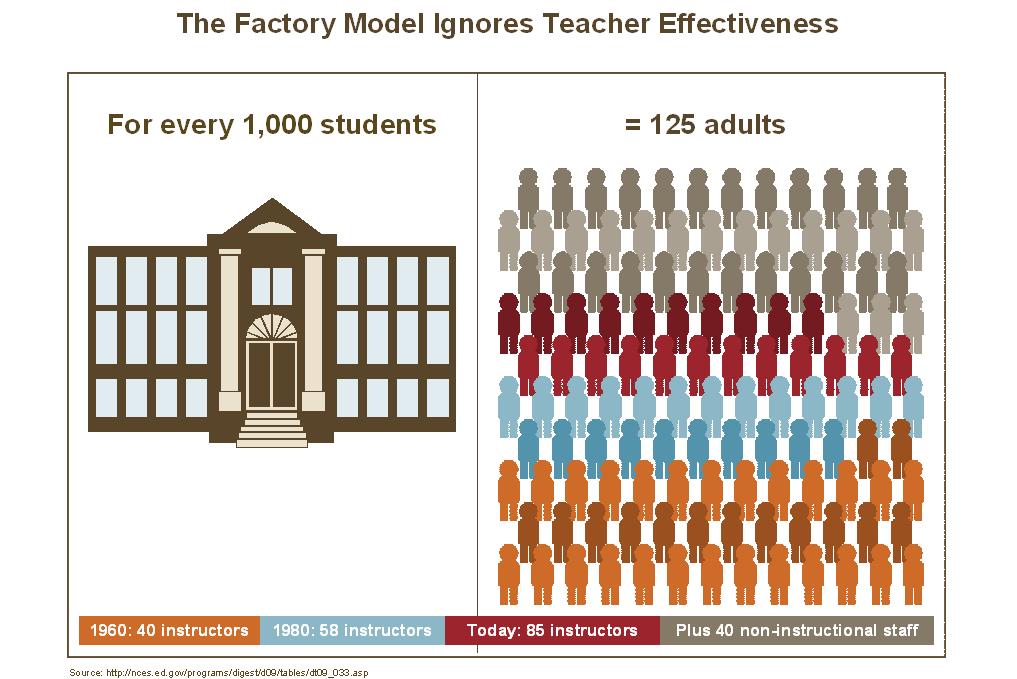
Here's my last slide from the Bill Gates presentation, showing the growth in education personnel from 1960 through the present.
The numbers of people employed at our schools  -- the teachers, teacher coaches, administrators, specialists, and other adults in the system  -- has exploded from 40 adults per 1,000 kids to 125 adults per 1,000 kids. That kind of employment growth is the reason that education has become very, very expensive. But for all of those very expensive adults employed at all levels of a particular school district, we have had almost no change in the results.

One solution is to increase class sizes for our very best teachers and eliminate our very worst teachers. Everybody else has got to improve.

Thursday, March 24, 2011

Teacher Evaluations and LIFO

The Education Committee is considering a bill that has the potential to take a step in the right direction: senate bill 1160. Last week, the committee heard testimony on this bill, all of which can be found here:

Public Testimony

The bill would empower the Performance Evaluation Advisory Council (PEAC) to create a model teacher evaluation system.That sounds like a good thing, except that the legislation almost ensures that the system that is eventually created will not be fair, nor will it be created by people with student's best interests in mind.

The people assigned to the PEAC are all school board, administrator, or union reps. Nobody on the Council is there to represent parents or students. And these days, I find if hard to believe that union reps actually represent teacher views anymore. I could be wrong on that.

In addition, the law requires the PEAC to look at everything except how well the teacher does in actually teaching students.

Friday, March 4, 2011

LIFO -- Connecticut considers a change

It is impossible to watch, read, or browse the news without noticing that teacher tenure is the latest hot button issue in the ed reform world. Once again, politics on this particular issue have changed, quite radically in fact, in just the past month. Democratic Governor of Connecticut, Dannel Malloy said in his budget address that he wanted  “to give local school districts the flexibility they need to retain new, talented teachers."

For those who missed the code in that statement, Gov Malloy was attacking one of the standard provisions of most contracts between teacher unions and school districts -- the "Last In, First Out" or LIFO rule. The last to be hired, is the first to be fired.

A google news search gets hits in the thousands. Why has LIFO suddenly become the issue in ed reform? In my opinion, it is the scapegoat that lets everyone off the hook of real reform. Everyone is jumping on the bandwagon, and for what it is worth, LIFO rules are hard to justify.  One of the few that made an attempt to do just that was Maurice Berube in a letter to the editor at the NY Times. And even his defense is pretty weak -- protect teachers from outside pressure? And then he goes on with this:

"Moreover, critics of teachers’ unions do not take into account the fact that teaching is labor-intensive and teachers often burn out."

Um, geez Maurice, you don't think that teacher burnout is taken into account by the critics of LIFO? That is absurd.  Teacher burnout is exactly the point. Some teachers do burn out and they probably should not remain in the classroom. Why are you protecting burned out teachers? How does that help kids?

Moving beyond this tepid defense of LIFO rules, what about teacher pressure? Do LIFO rules insulate teachers from pressure? A union president in NY seems to think so according to this statement in the Times Union.

"In education and other fields, unions have stated that a retreat from seniority protections would leave workers at peril of subjective evaluations, and worse. "We will not allow a bill that exposes our members to harassment, favoritism and intimidation to divert us from our commitment to defend collective bargaining and the right to organize," Iannuzzi said."
 
But not so fast. Has this LIFO rule actually protected teachers from harassment, favoritism, intimidation, or other inappropriate pressures? My informal and unscientific answer is no.
 
Teachers are besieged by outside pressure, by the very harassment the unions claim to protect them from. They have lost control of the content they teach and the methods by which they teach it. The number one complaint I hear from teachers is that they can't teach what they have been trained to teach nor what they know they should be teaching. How are teachers protected from outside pressure if a principal has firm instructions to her staff as to what must happen in a classroom on the days the superintendent is observing?

In other words, when the big guy is in the building, there will be no spelling tests, no kids sitting doing work, no paper and pencil stuff. Kids must be running around the room and using the SMART board. Throw your lesson plan out the window and get the kids up. Make it look like they are active and engaged.

This probably isn't what most people would consider "protecting teachers from outside pressure."

So why not end LIFO rules? The only real reason I can come up with is that exactly the opposite of the current situation will occur. Rather than fire all the newest teachers during layoffs, all the senior teachers will be fired instead. Such a result would be troubling. I've yet to find any teacher that didn't improve after 1 or 2 years on the job. Maybe its an indictment of our teacher training system that so many enter the classroom in their first year and find themselves shellshocked by how difficult the job is. I'm willing to put up with a brand new teacher, because you know they will get better. But no one believes a teacher is at their most effective in that first year or two on the job.

Simply tossing out LIFO rules is not likely to improve teacher quality. It may actually get worse. But at least it will get cheaper.

My biggest concern about the entire LIFO debate is that there is almost no discussion on how to fairly evaluate teachers. How will we retain the most talented teachers, in the absence of LIFO, if we can't even identify who they are? There won't be any more effort to keep the talented effective teachers without LIFO as there was with LIFO. But budgets will be balanced by firing the most senior teachers, the teachers with the least ability to get re-hired somewhere else regardless of their talents and abilities.

LIFO rules need to go, but we've got to have a system in place before LIFO is ended that gives us some degree of confidence that the talented teachers can be identified and retained. The teacher is the most important element in a child's success in school. Until we get serious about teacher evaluations, quick fixes that are popular with politicians and that play well in the press, will divert attention to the more difficult and more important problems of education reform.

Tuesday, February 1, 2011

Confusing Middle School Assignment

Over at Education Quick Takes, Grace describes an ill-conceived middle school writing assignment. It is a good example of the sorts of things that drive me crazy as a parent. If the teacher doesn't (or can't) proof-read the assignment for clarity of communication, exactly how will he or she impart to students the skills they need to learn to write effectively.

Because it is an English class, the teacher should really be held to the highest standard in her own written communications to the students. Unfortunately, this example is no exception.

I am reminded of one particularly horrible 8th grade English assignment from last year. After my daughter, another parent, and I discussed the assignment at length we finally reached some sort of conclusion about what the teacher might have meant. The worst part of it was, the assignment had so little merit. If I'm remembering correctly, they had to create an action figure based on something they were reading.

Tuesday, November 16, 2010

ROSEMARY: We're NUMBER 10! We're NUMBER 10!

After attending the Connecticut Forum at the Bushnell in Hartford last Thursday night, I have to admit – my head is spinning. The topic: Our Great Education Challenge.

Norah O’Donnell of MSNBC was the moderator, while the panelists were: Lily Eskelsen, Vice-President of the National Education Association, Deborah Gist, Rhode Island Commissioner of Education, Jon Schnur, Education Reform Pioneer and CEO of New Leaders for New Schools, Davis Guggenheim, Director of the film Waiting for Superman and my favorite panelist, Joel Klein, Chancellor, New York City Schools. Their bios can be seen by clicking on the link above.  The idea for the title of this post came from Mr. Schnur's remarks about how education in the U.S. has not gotten any worse (even though we have fallen from top place to number ten among industrialized nations in less than a generation), it just hasn't gotten any better.

The applause pattern at the event was most unusual.  It rippled around the Bushnell like a sort of Doppler Effect, mapping approval. The five panelists had distinct styles and often overlapped on ideas as often as they did not and all five had sympathizers in the audience.  So, depending on which of the panelists was responding to one of Ms. O’Donnell’s questions, one would hear either clapping, murmuring or grousing.  There was even a whoop or two.  And no matter who spoke, or who responded, I was dogged with this uneasy feeling that the point of our education challenge was never really addressed.  Kids do not need help with learning.  It’s what they do.  They are learning every waking minute and they are probably even learning in their sleep.  All environments are learning opportunities.  What they need help with is precisely the environment - the people, places and things that make up the culture of a school.  And the most important aspect of this environment, this culture is: WHAT are they learning? What constitutes the curriculum, and how are those decisions made?  How come there weren't any of the big textbook publishers on the panel?

Unbelievably, this was never addressed.  A lot of stuff about what children are not learning was bandied about, a lot of stuff about different classroom situations was put out there for discussion and a lot of stuff about what individual schools are “doing right” -creating a feeling of access and friendliness for parents and offering vibrant, rich classrooms - were offered up for pondering.  I only remember one remark addressing curriculum content: Mr. Schnur, on how important it is for us to make the transition from education based on the needs of the industrial age to education based on the needs of the information age. Oh, and Mr. Klein mentioned that some of the students in his schools would have liked to have taken an online AP level physics course, but it would not have counted since a real teacher would not be involved.  He even went to Albany to plead his students’ cause, but to no avail.  (The Chancellor of the New York City Public School system, which boasts more students than the entire population of the city of Albany, goes hat in hand to the seat of state government only to be told that what he was proposing would violate the terms of the contract with the teachers’ union.) Mr. Guggenheim spoke in that weird shaggy-headed Hollywood mix of humility and arrogance about the "hopes and dreams" of the children and parents in his documentary (why, they are just like any parent anywhere!) and added that, all things considered, he was more worried about global warming. Ms. Eskelsen did her best to defend the indefensible (tenure being the most glaring example) and Ms. Gist seemed to be constantly testing the vibe and found that picking on Ms. Eskelsen was her best bet as far as the sharing went.  And Norah O’Donnell deflected a little heat from the discussion by having everyone applaud all the educators in the audience and on the stage because Lord knows it’s a tough, important job.  She then undid that a bit later with a wisecrack about journalists not having tenure to protect them if they aren’t very good at what they do.

So what are many kids learning?  They learn that their learning doesn’t “count” if an educator isn’t the gatekeeper, and they then learn not to bother learning a subject if it won’t “count.”  They learn they can’t be trusted to learn on their own.  They learn that in some school systems, teachers are not allowed to stay late for enrichment opportunities.  They learn that if a teacher is not a good teacher, it doesn’t really matter.  They learn that if a teacher is a good teacher, it all comes to an end in ten short months and there’s no guarantee another good teacher will be waiting for them in September. The intention for students to learn these things is not explicit, but the way the system operates creates unavoidable consequences. Finland was offered up as an example of an admirable teacher training model featuring master teachers molding young teachers for pedagogical excellence, much as an attending physician leads around his or her gaggle of interns, residents or fellows.  (Apparently, the cream of the graduating Finnish university student crop goes into the teaching profession.)  Finland, however, is dazzlingly racially homogenous - where 93% of the population are Finns and 6% are Swedes.  Blondes and more blondes, but they do have that “Swedish as a Second Language” issue, so maybe the analogy can work. Ms. Eskelsen further expounded that Finland is doing right what "Teach for America" has backwards and then ...! She got an earful from Mr. Klein and Mr. Guggenheim, who apparently love "Teach for America."  Delving into the "Teach for America" dialectic beckons  to be fodder for a future blog post, but I have a feeling unions will be involved yet again.

My friend Lynn assures me that when Joel Klein alluded to the notion that the teachers’ unions might not be “in it for the children,” she sat up and took notice.  She told me that was about as radical a thing as she has ever heard in discussions of how we are to go about reforming education.  Lynn is quite sure it might be the beginning of a real dialogue on the subject.  I am not so sure.  I have done what Davis Guggenheim referred to as “take care of my own.”  I spent a good many years with children in the public school system, but in 1993 I began to homeschool.  Over the course of this blog, I hope to explain why I think the system itself is broken. 

In closing, here’s a quote from a true education reform pioneer, teacher John Taylor Gatto: "I've come to believe that genius is an exceedingly common human quality, probably natural to most of us … I began to wonder, reluctantly, whether it was possible that being in school itself was what was dumbing (my students) down. Was it possible I had been hired not to enlarge children's power, but to diminish it? That seemed crazy on the face of it, but slowly I began to realize that the bells and the confinement, the crazy sequences, the age-segregation, the lack of privacy, the constant surveillance, and all the rest of the national curriculum of schooling were designed exactly as if someone had set out to prevent children from learning how to think and act, to coax them into addiction and dependent behavior."

Educators may have “one of the hardest, most important jobs in the world,” but they also have the privilege of the company of our children for the best hours of the day, one-hundred-eighty days a year for six hours a day, doing work they love and have been trained to do. I contend that if we don’t admit that the focus on outcome is bogus when we won’t even talk about what our kids are learning, then the Great Education Challenge, or some permutation of it, will probably surface at the Connecticut Forum again, and in all likelihood, sooner rather than later.

To read the Connecticut Education Association's review of the Forum, click here  To read the Hartford Courant's assessment, click here. (And is it just me, or are there several grammar infractions in the first couple paragraphs of the Courant account? Tut tut.)