The Connecticut Post reported that the State Department of Education may try to get a law passed to make teachers caught cheating to pay for the costs of investigating and correcting the problems caused by their cheating.
It surely seems like a good idea -- the costs to the State of cheating scandals is large. Investigators have to be paid, students will need to be retested, and well, apparently there's a lot of money at stake. If teachers and administrators were involved in actually changing student answers to fake passing the CMT, then they clearly have some personal responsibility for their actions.
And what these "educators" have done is just like stealing.
But, that being said, they aren't the only ones to blame these days. There are a lot of people out there that have claimed to educate students, but given them a sham. The State is to blame for setting such low and vague standards that they could be met merely by exposing students to a topic. Meeting the state standards should mean you've learned something. All too often the standards are set so low that anything will count.
Then there are the Boards of Education that set graduation requirements so low that a high school diploma ceases to mean anything. And the curriculum administrators that force teachers to use a new program because someone at a conference somewhere convinced them it would solve all of their problems, or purchased programs because they claimed to be "research-based" but never bothered to read or evaluate the quality of that research.
The textbook companies and myriad of education companies that create appealing, but vacuous, curriculum and materials, and reap the profits of our schools' failures. Yes, they are to blame too.
Or the schools of education that have set the bar so low, and removed all elements of content from the required knowledge of newly minted teachers, that they are not prepared (by any measure) to take on a classroom and succeed.
And then there are the unions and the teachers themselves, that have watched passively as their profession lost credibility and respect, and spent too much time protecting the incompetent and not enough time worrying about what is best for students.
And, finally, parents need to be honest ourselves. We've trusted too much, and we've happily believed that we could just pop the little ones on the bus and all would be well.
So let's beat up on the dishonest teachers of Waterbury -- those that knowingly changed student answers should pay the costs of their actions. But the widespread problems of our failing education system will not be addressed until we take a critical and honest look at all levels of the education bureaucracy. There is plenty of blame to go around.

Showing posts with label Lynn. Show all posts
Showing posts with label Lynn. Show all posts
Monday, August 15, 2011

Saturday, August 13, 2011
Lots of Education News
It is hard to believe how much activity the realm of education has experienced this summer. And Connecticut has been in the headlines for all the wrong reasons, it seems.
First, there was the Board of Education drama in Bridgeport -- in which the elected members decided to throw their hands in the air and leave all of the most difficult decisions to unelected persons appointed by the State. The sad thing is, the unelected Board looks much more promising than the disbanded Board that had been picked by the voters. Coleman has put together an impressive list of people to serve on the Bridgeport Board -- the retired President of Bridgeport Hospital, a professor of teacher preparation from Sacred Heart University, an executive from People's Bank in Bridgeport, and the list goes on. I wonder -- why didn't these people run for the Board? How come people of high caliber are willing to serve on the Board of a troubled school system, but are not willing to stand for election for the same Board? Actually, the answer is obvious, when you think about it. There are very few things most of us would find more unappealing than standing for election in any city in this country.
Second, the Waterbury School system continues to be rocked by the cheating scandal. In case you missed it, Waterbury teachers are suspected of changing student answers on the CMT to improve the scores of the students they failed to teach. The latest reports are that 17 teachers and administrators have been placed on leave. Seventeen! But the State insists that there's no evidence of widespread cheating in Connecticut. I wonder how hard the State is looking for such evidence?
Finally, the Connecticut teachers union made the mistake of posting on their website a power point presentation that was shocking in its self-congratulatory tone describing in detail how the union "succeeded" in denying parents the right to insist on closing or reforming perpetually failing schools. If you'd like to take a look at the power point -- here's a link to it: Parent Trigger Power Point
That seems like enough bad news for today.
First, there was the Board of Education drama in Bridgeport -- in which the elected members decided to throw their hands in the air and leave all of the most difficult decisions to unelected persons appointed by the State. The sad thing is, the unelected Board looks much more promising than the disbanded Board that had been picked by the voters. Coleman has put together an impressive list of people to serve on the Bridgeport Board -- the retired President of Bridgeport Hospital, a professor of teacher preparation from Sacred Heart University, an executive from People's Bank in Bridgeport, and the list goes on. I wonder -- why didn't these people run for the Board? How come people of high caliber are willing to serve on the Board of a troubled school system, but are not willing to stand for election for the same Board? Actually, the answer is obvious, when you think about it. There are very few things most of us would find more unappealing than standing for election in any city in this country.
Second, the Waterbury School system continues to be rocked by the cheating scandal. In case you missed it, Waterbury teachers are suspected of changing student answers on the CMT to improve the scores of the students they failed to teach. The latest reports are that 17 teachers and administrators have been placed on leave. Seventeen! But the State insists that there's no evidence of widespread cheating in Connecticut. I wonder how hard the State is looking for such evidence?
Finally, the Connecticut teachers union made the mistake of posting on their website a power point presentation that was shocking in its self-congratulatory tone describing in detail how the union "succeeded" in denying parents the right to insist on closing or reforming perpetually failing schools. If you'd like to take a look at the power point -- here's a link to it: Parent Trigger Power Point
That seems like enough bad news for today.
Monday, July 11, 2011
Still More on Vocational and Technical Education
In case you missed it, the New York Times did a long article on Saturday on the fate of Career and Technical Education schools: Tough Calculus as Technical Schools Face Deep Cuts.
Federal funding to vocational and technical schools could be cut by 20% in the next budget. In States like Connecticut, where state funding is disappearing as well, this could mean the closing of many technical high schools.
These cuts are baffling -- technical high schools have a much higher graduation success rate than general "comprehensive" high schools -- 90% for technical high schools v. 75% at a traditional high school.
And the success of these schools doesn't come by lowering standards. In fact, in a recent survey, employers were much happier with students coming from technical high schools than traditional ones.
And the Times article points to a Massachusetts analysis that technical high school graduates actually do better on reading and math tests than traditional high schools. With such a strong record of achievement, our elected leaders would do better increasing funding to technical high schools, rather than cutting it.
Federal funding to vocational and technical schools could be cut by 20% in the next budget. In States like Connecticut, where state funding is disappearing as well, this could mean the closing of many technical high schools.
These cuts are baffling -- technical high schools have a much higher graduation success rate than general "comprehensive" high schools -- 90% for technical high schools v. 75% at a traditional high school.
And the success of these schools doesn't come by lowering standards. In fact, in a recent survey, employers were much happier with students coming from technical high schools than traditional ones.
And the Times article points to a Massachusetts analysis that technical high school graduates actually do better on reading and math tests than traditional high schools. With such a strong record of achievement, our elected leaders would do better increasing funding to technical high schools, rather than cutting it.
Tuesday, June 21, 2011
Where did this past month go?
Yes, it has been a crazy month and neither Rosemary nor I have written a thing on our blog. Apologies to all. There have been graduations and travel and start of summer activities a plenty. Many days were spent doing interesting things, but computers were not a part of it.
In the meantime, here is a new blog to watch. Grace is putting up some interesting posts -- go check her out!
Cost of College
In the meantime, here is a new blog to watch. Grace is putting up some interesting posts -- go check her out!
Cost of College
Friday, May 20, 2011
Vocational Education -- Rethinking its role in the U.S.
One of the many interesting things that "The Finland Phenomenon" brought out was the embracing of vocational and technical education in public high schools. According to the film, about 40% of Finnish students choose a vocational track in secondary school. They learn and train for careers and are immediately employable after graduation.
The U.S. on the other hand has a monumental disdain for anything that smacks of "tracking." The result is that an unacceptably high number of students choose to drop out of high school, or pay for vocational training after high school. Too many of our adolescents know that they have no interest in pursuing college, and yet, that seems to be the only option our educational system wants to prepare them for.
Of the 18,000 public high schools in the U.S., about 900 are vocational (or about 5%) according to the U.S. Department of Education statistics. Why the disdain? Why are we so reluctant to encourage teens to pursue careers as welders, electricians, computer technicians, or health care workers? These are good jobs and for many students, learning something useful would be better than marking time in a "comprehensive" high school completing low level academic courses.
The Economist article raises a good point.
Vocational and technical (now called Career and Technical Education or CTE) is so despised, that few kids are ever encouraged to pursue it, despite the clear benefits of higher wages and less time in training. The Economist article found statistics that show adult men with CTE training were more likely to be married and to have a 17% higher income.
The discussion following the Finland Phenomenon highlighted how badly we serve the needs of our youth with our current system. By age 25, the U.S. has a terrible record of achievement -- only 30% of 25 year old have completed a 4 year college degree and only an additional 10% have earned a 2 year associates degree. That means that 60% of our 25 year olds are either in the category of "some college" or no college. With results like that, its time to rethink our cultural disdain for vocational education.
The U.S. on the other hand has a monumental disdain for anything that smacks of "tracking." The result is that an unacceptably high number of students choose to drop out of high school, or pay for vocational training after high school. Too many of our adolescents know that they have no interest in pursuing college, and yet, that seems to be the only option our educational system wants to prepare them for.
Of the 18,000 public high schools in the U.S., about 900 are vocational (or about 5%) according to the U.S. Department of Education statistics. Why the disdain? Why are we so reluctant to encourage teens to pursue careers as welders, electricians, computer technicians, or health care workers? These are good jobs and for many students, learning something useful would be better than marking time in a "comprehensive" high school completing low level academic courses.
The Economist article raises a good point.
America has a unique disdain for vocational education. . . . . However, many Americans hate the idea of schoolchildren setting out on career paths—such predetermination, they think, threatens the ethos of opportunity.This is the same sort of thinking (the every child is a unique snowflake thinking) that led us to such destructive curricular choices in K-12 education. In our attempts to educate every single child in their own unique way (differentiated instruction with whole inclusion of SPED), we have adopted curricula that are a mile wide, an inch deep, and so obsessed with not offending anyone at any time, that it fails to meet the fundamental objective of actually educating the kids.
Vocational and technical (now called Career and Technical Education or CTE) is so despised, that few kids are ever encouraged to pursue it, despite the clear benefits of higher wages and less time in training. The Economist article found statistics that show adult men with CTE training were more likely to be married and to have a 17% higher income.
The discussion following the Finland Phenomenon highlighted how badly we serve the needs of our youth with our current system. By age 25, the U.S. has a terrible record of achievement -- only 30% of 25 year old have completed a 4 year college degree and only an additional 10% have earned a 2 year associates degree. That means that 60% of our 25 year olds are either in the category of "some college" or no college. With results like that, its time to rethink our cultural disdain for vocational education.
Thursday, May 5, 2011
Students need to understand the Solution of a Problem -- We've heard this before
It's been well over 150 years since Massachusetts became the first state to demand compulsory education by law. The idea that every child must attend school was radical at the time, but now is broadly accepted around the world. While some things have changed -- such as the size of schools and number of administrators -- some things have remained persistent issues.
Whenever I get a little too immersed in the rhetoric of the "21st Century Skills" movement, at those times when it seems like every commentator and blogger and administrator is singing the same tune about the different needs of today and how today's child is so different from yesteryear's -- at those times, I like to go back and read about the concerns and issues of 1900 and reflect upon what hasn't changed.
Here's what hasn't changed: 1) It is very difficult to identify good teachers. 2) Retaining good teachers is difficult, 3) Students need to be able to solve problems, and 4) Students need to understand what they are doing and shouldn't just memorize answers.
These were the top issues in 1903. They are still the top issues today in 2011. It's good to remember that we still haven't solved the education problems of 1903, they are with us today.
In advance of tonight's premiere of The Finland Phenomenon, I've read Tony Wagner's book -- The Global Achievement Gap. Tony might be surprised that back in 1903, educators were worried about the need for better teachers and the focus on problem solving and understanding. Tony might also be very surprised by how many of his "reforms" were thought of by others long ago.
I have seen fully demonstrated the past year that the best educated are not always the best teachers, though it is often thought that a person who passes high in examination or holds a state certificate, is fully competent for any district school.
To be able to master books is not enough. One should possess either a trained or natural ability to impart in a manner comprehensible to the young mind.
If the pupil is not made to understand the solution of a problem but little is gained. I find a deficiency too often in this respect which intercepts the best results.This was taken from the "Annual Report of School Visitors to the Town of Granby" dated 1903.
Whenever I get a little too immersed in the rhetoric of the "21st Century Skills" movement, at those times when it seems like every commentator and blogger and administrator is singing the same tune about the different needs of today and how today's child is so different from yesteryear's -- at those times, I like to go back and read about the concerns and issues of 1900 and reflect upon what hasn't changed.
Here's what hasn't changed: 1) It is very difficult to identify good teachers. 2) Retaining good teachers is difficult, 3) Students need to be able to solve problems, and 4) Students need to understand what they are doing and shouldn't just memorize answers.
These were the top issues in 1903. They are still the top issues today in 2011. It's good to remember that we still haven't solved the education problems of 1903, they are with us today.
In advance of tonight's premiere of The Finland Phenomenon, I've read Tony Wagner's book -- The Global Achievement Gap. Tony might be surprised that back in 1903, educators were worried about the need for better teachers and the focus on problem solving and understanding. Tony might also be very surprised by how many of his "reforms" were thought of by others long ago.
Monday, May 2, 2011
City Schools Are Taking on the Competition
I doubt anyone will decide to forego a seat in a top charter or magnet school based on this video, but I see it as a very positive sign of change. The Hartford Public School system, one of the worst public school system in the country, has a long way to go to actually convince parents that they should keep their kids in the local neighborhood school. But, the schools are finally understanding something very important. People want quality and they have choices. Right now, according to one news source, 28% of minority students choose to leave the Hartford School System.
Under a settlement with the Scheff plaintiffs, the schools need to meet 80% of the demand for charters, magnets, or sending kids to the suburbs. The Hartford schools have decided it might be easier to reduce demand. They have made some improvements to the quality of education and are now actively trying to court parents and students to stay.
I wish every school system had the same incentives and consequences for failing to improve. Competition is a really wonderful thing. Improving the quality of the schools in Hartford is the best possible outcome for the kids in Hartford. I'm very glad to see the city taking it seriously.
Under a settlement with the Scheff plaintiffs, the schools need to meet 80% of the demand for charters, magnets, or sending kids to the suburbs. The Hartford schools have decided it might be easier to reduce demand. They have made some improvements to the quality of education and are now actively trying to court parents and students to stay.
I wish every school system had the same incentives and consequences for failing to improve. Competition is a really wonderful thing. Improving the quality of the schools in Hartford is the best possible outcome for the kids in Hartford. I'm very glad to see the city taking it seriously.
Thursday, April 28, 2011
Why Connecticut's Schools are Lagging
I'm re-posting from an excellent Westport Patch article going through the litany of why CT fares so much worse than residents believe. You can find it here: Why Connecticut Schools are Lagging.
To the extent readers don't think that CT residents are delusional on this point, I point to our town budget hearing of two weeks ago. The President of the local PTO stood up and said she couldn't believe her luck in moving to town, because the schools just keep getting better and better. Even those opposed to the budget kept their comments focused on the need to cut spending and keep taxes down while maintaining the excellence of the schools. No one ever says out loud in public that the schools are not all they are cracked up to be.
The Westport Patch article is spot-on. My only complaint is that it misses two of the most critical reasons as to why our CT schools lag. The first -- horrible curriculum foisted upon us through the State DOE through vague state standards and state consultants that actually recommended poor curriculum to local districts. Any parent that has ever complained about the use of Everyday Math has heard the same justification that I have: it meets the State Standards. The State actually insists that we use this wretched curriculum, despite its short-comings, despite the parents' opposition to it and despite the rather weak research background of the program. The same goes for the whole language and balanced literacy that has largely replaced phonics and grammar.
The second reason that CT will continue to fail is the poor quality of our schools of education. Add to this, the difficulty teachers have crossing from state borders. A certified teacher from another state (with higher standards) must jump through hoops and incur expenses to teach in CT. Because we have a very small state, we should not be slamming our doors at the border to good teachers wishing to move in. The inability to easily move between states means that CT is overly reliant upon teachers graduating from our own in-state teacher colleges. That would be okay if those colleges were producing top-notch teachers, but that is simply not the case.
Anyway, from the Westport Patch, Nathan Allen says this about the Achievement Gap:
To the extent readers don't think that CT residents are delusional on this point, I point to our town budget hearing of two weeks ago. The President of the local PTO stood up and said she couldn't believe her luck in moving to town, because the schools just keep getting better and better. Even those opposed to the budget kept their comments focused on the need to cut spending and keep taxes down while maintaining the excellence of the schools. No one ever says out loud in public that the schools are not all they are cracked up to be.
The Westport Patch article is spot-on. My only complaint is that it misses two of the most critical reasons as to why our CT schools lag. The first -- horrible curriculum foisted upon us through the State DOE through vague state standards and state consultants that actually recommended poor curriculum to local districts. Any parent that has ever complained about the use of Everyday Math has heard the same justification that I have: it meets the State Standards. The State actually insists that we use this wretched curriculum, despite its short-comings, despite the parents' opposition to it and despite the rather weak research background of the program. The same goes for the whole language and balanced literacy that has largely replaced phonics and grammar.
The second reason that CT will continue to fail is the poor quality of our schools of education. Add to this, the difficulty teachers have crossing from state borders. A certified teacher from another state (with higher standards) must jump through hoops and incur expenses to teach in CT. Because we have a very small state, we should not be slamming our doors at the border to good teachers wishing to move in. The inability to easily move between states means that CT is overly reliant upon teachers graduating from our own in-state teacher colleges. That would be okay if those colleges were producing top-notch teachers, but that is simply not the case.
Anyway, from the Westport Patch, Nathan Allen says this about the Achievement Gap:
The fact is, poor and minority students are better educated in Florida and Texas than in Connecticut. Connecticut’s poor and Hispanic students are outscored by Moldova, and Connecticut’s black students barely beat Egyptian and Palestinian student scores. Our poor and minority students can’t outscore students from developing nations with 1/20th the per-capita income.And on our best students:
Internationally, Connecticut’s highest scoring 8th graders score behind Slovenia, Estonia, and Poland in math on the Programme for International Student Assessment (PISA). And these are our best students.
Friday, April 22, 2011
The Blame Game -- from the School Institution Point of View
The current issue of The Nation contains this: Teachers are not the Enemy.
I wanted very much to embrace the premise of this article. As a proud lefty, I am not interested in bashing unions for the fun of it. I was really hoping to find a spirited defense of teachers and unions that would point a way forward toward school improvement. For the past decade, the efforts to improve the schools came mostly from the right. The left has tended to defend the status quo, while requesting ever larger quantities of money. It has been disheartening to those of us that think we need to change the way we are doing things, but would like to believe that the teacher union should have a seat at the table and be a part of the process.
So I had high hopes for the article in the Nation. We need the left to engage in the debate on how to make the changes we need to make without dismantling the good with the bad. Unfortunately, I was once again disappointed.
You will not find an acknowledgment anywhere in the Nation's article that the current system sucks for a whole lot of kids and families, that for even our best and brightest (and best funded) schools are not keeping pace internationally with their peers, that those in our urban schools are dropping out in shockingly high numbers and those that graduate are woefully unprepared for college level work.
What will you find in the article? You will find a list of evils that teachers oppose -- vouchers, charter schools, merit pay, eliminating seniority preferences, using student achievement as a measure of teacher or school quality, closing schools that fail year after year, and changing any of the bargained for perks of many teacher contracts.
You will find strongly worded criticism of all reforms that have been proposed. But you won't find a single new idea on how to improve the results of our failing schools. You won't find an appeal to research on what has worked in particular states or countries that have dramatically improved the quality of their educational system.
You will find that the only solution being offered is the same one we've tried and tried for the past decade or more -- just give them more money for more counselors, more teachers, more professionals. The writers give us no reason to expect a different result this time around. At best, they use a couple anecdotes and no data to suggest we will see "marked student improvement."
At this point, anyone that wants more of anything (particularly tax dollars) had better be able to point to some hard data and solid research for their claims -- "trust us" just isn't good enough anymore.
I wanted very much to embrace the premise of this article. As a proud lefty, I am not interested in bashing unions for the fun of it. I was really hoping to find a spirited defense of teachers and unions that would point a way forward toward school improvement. For the past decade, the efforts to improve the schools came mostly from the right. The left has tended to defend the status quo, while requesting ever larger quantities of money. It has been disheartening to those of us that think we need to change the way we are doing things, but would like to believe that the teacher union should have a seat at the table and be a part of the process.
So I had high hopes for the article in the Nation. We need the left to engage in the debate on how to make the changes we need to make without dismantling the good with the bad. Unfortunately, I was once again disappointed.
You will not find an acknowledgment anywhere in the Nation's article that the current system sucks for a whole lot of kids and families, that for even our best and brightest (and best funded) schools are not keeping pace internationally with their peers, that those in our urban schools are dropping out in shockingly high numbers and those that graduate are woefully unprepared for college level work.
What will you find in the article? You will find a list of evils that teachers oppose -- vouchers, charter schools, merit pay, eliminating seniority preferences, using student achievement as a measure of teacher or school quality, closing schools that fail year after year, and changing any of the bargained for perks of many teacher contracts.
You will find strongly worded criticism of all reforms that have been proposed. But you won't find a single new idea on how to improve the results of our failing schools. You won't find an appeal to research on what has worked in particular states or countries that have dramatically improved the quality of their educational system.
You will find that the only solution being offered is the same one we've tried and tried for the past decade or more -- just give them more money for more counselors, more teachers, more professionals. The writers give us no reason to expect a different result this time around. At best, they use a couple anecdotes and no data to suggest we will see "marked student improvement."
At this point, anyone that wants more of anything (particularly tax dollars) had better be able to point to some hard data and solid research for their claims -- "trust us" just isn't good enough anymore.
World Premiere of the Finland Phenomenon
On May 5, the new Bob Compton documentary, "The Finland Phenomenon" will premiere at MIT in Boston. I'd love to go -- but it's invitation only.
Following the screening, a panel discussion including the Mass Secretary of Education will take place. Tony Wagner, author, educator, and researcher of education, will also be on the panel. Wagner is the Innovation Education Fellow at Harvard's Technology and Entrepreneurship Center. Wagner wrote The Global Achievement Gap.

Following the screening, a panel discussion including the Mass Secretary of Education will take place. Tony Wagner, author, educator, and researcher of education, will also be on the panel. Wagner is the Innovation Education Fellow at Harvard's Technology and Entrepreneurship Center. Wagner wrote The Global Achievement Gap.

Thursday, April 21, 2011
Technology, digital natives, and the future of education
Technology, and in particular -- games -- in the classroom are only the latest example of fads sweeping the education establishment. This particular fad is likely to persist for some time for a number of reasons: 1 ) kids like playing games, they are "engaging" 2) computer games are very expensive (which means they must be good in the world of education), and 3) someone else does all the hard work (and gets paid well for it).
The video linked to above is one of the more recent efforts to bring technology into the classroom. This particular game is aimed at teaching microbiology to 8th graders. Players try to figure out what is causing a dangerous infectious disease outbreak on an island filled with scientists.
This particular game is worth looking at more closely. It has received a lot of support (i.e., money) from the National Science Foundation ($4 million) and was created by a collaboration of the North Carolina State University College of Education, College of Design, and the Institute for Educational Innovation. The game has received high praise from teachers and the education establishment:
Edweek also carried a glowing article about Crystal Island, quoting one of the developers of Crystal Island:
To get beyond whether the game is fun, I tried to find out how much Crystal Island actually improves learning. This was no easy task. Most of the comments and articles surrounding the game dwell on student engagement and give us little information on what students actually learn. There is an implicit assumption that if students are engaged, they will be learning.
I found one research paper written by the developers of Crystal Island here: http://research.csc.ncsu.edu/intellimedia/papers/wieg-09.pdf
I also found a literature review of Serious Games (which includes a review of Crystal Island) at the U Mass Computer Science Department: A Literature Review of the Field of Serious Games.
Kids that played Crystal Island correctly answered TWO additional questions after they played the game for an hour. As for the kids in the traditional classroom?
So I remain very skeptical of the benefits of technology and game playing in the classroom. For the amount of time the kids played the game (60 minutes) to improve their content knowledge by only two questions, it seems that this is a very inefficient way to learn. Add to that the high cost of developing the game and installing the technology into classrooms and the limited focus of the game, it just can't be justified at this time.
The video linked to above is one of the more recent efforts to bring technology into the classroom. This particular game is aimed at teaching microbiology to 8th graders. Players try to figure out what is causing a dangerous infectious disease outbreak on an island filled with scientists.
This particular game is worth looking at more closely. It has received a lot of support (i.e., money) from the National Science Foundation ($4 million) and was created by a collaboration of the North Carolina State University College of Education, College of Design, and the Institute for Educational Innovation. The game has received high praise from teachers and the education establishment:
"Today’s class was fully engaged and I have already gotten emails from a number of students asking for the web address so that they can continue playing from home." (from a teacher blog).
Edweek also carried a glowing article about Crystal Island, quoting one of the developers of Crystal Island:
“It’s absolutely the case that kids are very engaged [while playing the game],” says Lester, who is also the head of the IntelliMedia Group. “You can see it on their faces and the way they interact with the software.”The same article quotes an 11-year-old that played the 5th grade version of Crystal Island:
“The game made me like science a little bit more, because in science sometimes you have to look through a textbook and that’s not fun,” she says. “But in a game you actually get to choose your character and pick out [choices based on] your own interests.”Engagement and fun are all well and good. They really are. I think every teacher and parent would like to see kids learn AND have fun, whenever possible. Of course, there are real risks to elevating "engagement" -- too often the content and knowledge are watered down to make the game more appealing and engaging. Projects that are fun can be given preference over the not-so-fun but really important stuff. Such as grammar and learning long division.
To get beyond whether the game is fun, I tried to find out how much Crystal Island actually improves learning. This was no easy task. Most of the comments and articles surrounding the game dwell on student engagement and give us little information on what students actually learn. There is an implicit assumption that if students are engaged, they will be learning.
I found one research paper written by the developers of Crystal Island here: http://research.csc.ncsu.edu/intellimedia/papers/wieg-09.pdf
I also found a literature review of Serious Games (which includes a review of Crystal Island) at the U Mass Computer Science Department: A Literature Review of the Field of Serious Games.
Crystal Island features a fully 3D interface and environment in which players explore, and collect important information by meeting and conversing with other agents. Players can collect other information through realistic events such as reading newspapers or examining objects in the environment. In this same way, players in general are given a large amount of freedom. The theory is that student motivation will rise when the sense of freedom within a game is increased. This is because students can quickly judge how much there is to discover within a system. When they detect a vast and interesting world, they wish to explore it, and freedom within a game allows them to do just that.
There is little mention on the trade off between providing students with freedom within a simulation and manually focusing students on chosen tasks. It can be argued that although providing freedom to users increases motivation, it may not lead to learning because students might tend to engage in unproductive tasks. Likewise, forcing student efforts may lead to desired actions within the system, but a loss of engagement may be a great detriment to learning. This trade off must be thoroughly analyzed in future serious games research, although intelligent tutoring research may do a great deal in informing the likely result of the trade off.An interesting part of the paper was the paradox of trying to make the content of a game strong, without destroying the enjoyment factor. Some feel that this paradox is impossible to overcome. The paper also makes the interesting point that:
Unfortunately, students have been shown to be particularly good at recognizing when a simulation is trying to “trick” them into learning.So now, I return to the only research paper on Crystal Island, published by the developers. 8th grade students participated in an actual test of the game. Kids were tested before they played the game on various elements of microbiology, they were allowed to play the game, and then they were tested again. Another group of students also participated in the study, but they were given traditional lecture-style instruction by a teacher with a slide show and did not play the game.
Kids that played Crystal Island correctly answered TWO additional questions after they played the game for an hour. As for the kids in the traditional classroom?
The results showed that students [that played the game] did exhibit learning gains, but that those gains were less than those produced by traditional instructional approaches.In other studies, the gains may have been better, but the data isn't clear. The developers still insist that the benefits of motivation and engagement are "substantial" (but unquantified). Also, students that took notes during the game did better and girls were more likely than boys to use the note-taking capabilities built into the game.
So I remain very skeptical of the benefits of technology and game playing in the classroom. For the amount of time the kids played the game (60 minutes) to improve their content knowledge by only two questions, it seems that this is a very inefficient way to learn. Add to that the high cost of developing the game and installing the technology into classrooms and the limited focus of the game, it just can't be justified at this time.
Thursday, April 14, 2011
Flip The Curve!

In our continuing search for solutions to the education crisis, we should all be encouraged by the growing recognition of the value of great teachers. The best teachers get results consistently, year after year, with all of their students. It isn't magic and it isn't luck.
For too long, the role of great teachers has been diminished. Teachers have been viewed as fungible -- just another input into a system that has valued laptops and school buses as much as they have valued teachers. As long as a teacher graduated from a collegiate teacher prep program and passed the State certification test, then one was just as good as another. Results and skills have gone unremarked and unrewarded. The only way to boost your pay as a teacher was to get another degree, move out of the classroom in the bureaucracy or the administration, or just stay longer. Our pay scales and our entire teacher recruiting system is perfectly structured to encourage the best teachers to stop teaching, to get more degrees, to become a bureaucrat.
Teachers that simply teach, and teach well, are not the goal of our education system. Which brings me to the chart at the top of this post. The chart was included in a presentation by Bill Gates to the National Governor's Association last month. I think my friends at KitchenTableMath were the first to note the disparity between how much we spend on education and the lack of results for our money.
There's nothing new here -- the amount spent, per pupil, has increased dramatically, every year for decades. The results have been flat, as measured by the NAEP (which is the only test given nationwide to 4th and 8th graders and allows us to compare apples to apples across the States).
The US has got to figure out a way to increase the quality of education results but hold costs flat. There will be tremendous resistance to this idea. Just two nights ago, I was told again at my town budget discussions that flat spending in education is really a cut.
Here's my last slide from the Bill Gates presentation, showing the growth in education personnel from 1960 through the present.
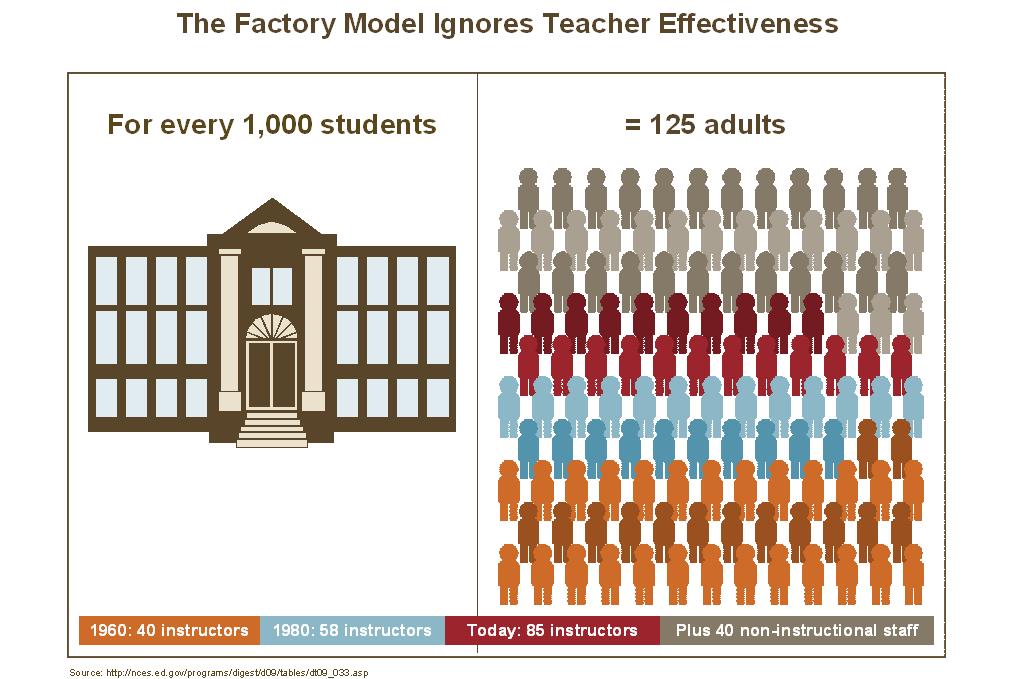
One solution is to increase class sizes for our very best teachers and eliminate our very worst teachers. Everybody else has got to improve.
Wednesday, April 6, 2011
Parents and Coaches -- an interesting interaction for education
I'm sharing a video that my daughter's gymnastics coach pointed out to me yesterday. It is rather long, but hilarious if you've ever watched the progression of little girls through the levels. The parent and coach in this are extreme caricatures, to be sure, but there are a couple of points that are relevant to any discussion of education.
First, the "coach" doesn't blame Suzie for a lack of talent or ability to learn the kip and move to level 5. In fact, the coach insists that hard work, persistence, patience, and a commitment to the sport will pay off. But skipping practice and negative feedback have Suzie in a downward spiral.
Second, the bar coach spent much time explaining exactly what the component parts of a kip are, she explained the progression of each element that makes for a successful kip -- muscle, flexibility, and timing. Each part must be ready before the kip will work. There really is no short-cut and kids will work on this one stunt for months before they get it.
Second, the bar coach spent much time explaining exactly what the component parts of a kip are, she explained the progression of each element that makes for a successful kip -- muscle, flexibility, and timing. Each part must be ready before the kip will work. There really is no short-cut and kids will work on this one stunt for months before they get it.
Contrast this with much of the discussion we see in public education -- when students aren't performing at grade level you almost never hear about the importance of foundation skills, the building of knowledge, the identification of weaknesses, the importance of hard work, persistence, and patience.
Instead, the National Education Association has page after page of stories from teachers explaining that the kids they have just don't have the ability to work at grade level. Such as this:
"I watch their little faces get confused and even sad at times because they just do not have the abilities that other students have . . . ."or this:
"There is nothing worse than watching a student of yours struggle and not being able to help them. It is even worse when you know that they are going to become overwhelmed, and you still have to sit back and watch."These stories are most heart-breaking because the teacher does not have a plan to build the foundation and teach the skills. They are willing to write off students that just aren't smart enough. It's even sadder when you see other schools and teachers making great progress with the hard to teach kids -- those from poverty without English spoken at home.
When I read the NEA webpage stories, I feel very sorry for those kids that don't have teachers with a strong curriculum and strong skills and an attitude of hope. I wish we could get every kid a strong teacher and a cumulative progressive curriculum that builds the foundation skills the kids need. I wish they all had a teacher like the coach in the video.
Sunday, April 3, 2011
Small Changes to Town Education Budgets May Be Possible
A bill that would allow for a very limited reduction in town education budgets has a potential of passing this year. The change is incredibly small, and not nearly enough to give towns control over their budgets, but it is a start.
The Bill is "AN ACT IMPLEMENTING THE BUDGET RECOMMENDATIONS OF THE GOVERNOR CONCERNING EDUCATION" and is numbered 6385.
It would allow towns to reduce their education budgets IF they have declining enrollment. For every kid that their enrollment is reduced by, the town can reduce its budget by $3,000.
Connecticut has a very strange system of budgeting. Towns have little control over many aspects of spending, and this is a particularly insidious state law that has no justification. Whatever a town spends on education in one year, it is required to spend AT LEAST that much the next year. This is called the "Minimum Budget Requirement" and I've blogged about it in the past.
In a town such as Granby, the change would permit (not require) that the town COULD reduce spending on education by about $120,000 as we see about a 30 student decline in enrollment year-to-year. That will probably never happen, as we have been increasing our expenditures every year despite significant drops in student population (in the current year, 46 fewer students attended than the year before, and 79 fewer students attend the Granby Schools than they did just 3 years ago).
But don't expect any drops in budgeting as a result. The Board always has a way of making sure every dollar (and then some) is spent regardless of how many students we have. In fact, despite enrollment declines, the actual amount budgeted next year will likely grow, not shrink. This is true across the State -- towns typically budget more than required -- much more. In these difficult economic times, towns are proposing budgets of 1%, 2%, even 5% more than last year for education.
Even if Bill 6385 passes the legislature and is signed by Governor Malloy, the impact will be very small. Few towns are likely to reduce their education budget, and the new law would only apply to the next two fiscal years.
So why am I such a fan of removing the MBR, if I think it will have almost no impact? Because as a basic principal, I think towns should be able to control their spending. Parents and tax payers are not interested in destroying public schools. But it is also the people on the ground and in the schools that can best determine what their budget needs are. Does a playground need to be rebuilt this year? Did we have unusually large expenses last year that are not recurring? A drop in the number of special education students? An increase in bus routes?
School districts and towns need to be able to respond to changing conditions without a mechanical requirement that any increased cost in any particular year not become a permanent cost in the budget for every year after.
Bill 6385 is a small step in the right direction. Complete repeal of the law would be better.
The Bill is "AN ACT IMPLEMENTING THE BUDGET RECOMMENDATIONS OF THE GOVERNOR CONCERNING EDUCATION" and is numbered 6385.
It would allow towns to reduce their education budgets IF they have declining enrollment. For every kid that their enrollment is reduced by, the town can reduce its budget by $3,000.
Connecticut has a very strange system of budgeting. Towns have little control over many aspects of spending, and this is a particularly insidious state law that has no justification. Whatever a town spends on education in one year, it is required to spend AT LEAST that much the next year. This is called the "Minimum Budget Requirement" and I've blogged about it in the past.
In a town such as Granby, the change would permit (not require) that the town COULD reduce spending on education by about $120,000 as we see about a 30 student decline in enrollment year-to-year. That will probably never happen, as we have been increasing our expenditures every year despite significant drops in student population (in the current year, 46 fewer students attended than the year before, and 79 fewer students attend the Granby Schools than they did just 3 years ago).
But don't expect any drops in budgeting as a result. The Board always has a way of making sure every dollar (and then some) is spent regardless of how many students we have. In fact, despite enrollment declines, the actual amount budgeted next year will likely grow, not shrink. This is true across the State -- towns typically budget more than required -- much more. In these difficult economic times, towns are proposing budgets of 1%, 2%, even 5% more than last year for education.
Even if Bill 6385 passes the legislature and is signed by Governor Malloy, the impact will be very small. Few towns are likely to reduce their education budget, and the new law would only apply to the next two fiscal years.
So why am I such a fan of removing the MBR, if I think it will have almost no impact? Because as a basic principal, I think towns should be able to control their spending. Parents and tax payers are not interested in destroying public schools. But it is also the people on the ground and in the schools that can best determine what their budget needs are. Does a playground need to be rebuilt this year? Did we have unusually large expenses last year that are not recurring? A drop in the number of special education students? An increase in bus routes?
School districts and towns need to be able to respond to changing conditions without a mechanical requirement that any increased cost in any particular year not become a permanent cost in the budget for every year after.
Bill 6385 is a small step in the right direction. Complete repeal of the law would be better.
Friday, March 25, 2011
Malloy Gives Up On Fixing The School Funding Method
Governor Malloy's budget director gave up trying to get a "money follows the child" law passed this year. They will study it, despite admitting that the current school funding formula is broken and has been broken for years.
How broken is it? Well, when my son was in the 8th grade, he attended a magnet school in Hartford. One of his assignments in one of his classes was to actually read the funding formula law. Then students were to create their own funding formulas.
The one thing I remember both of us thinking at the end of the assignment was that the existing formula was so unbelievably complicated that it could not be explained to anyone.
My son is now in college and nothing has improved. The funding formula is opaque at best, and intentionally confusing at worst. There is nothing fair nor transparent about it. Now that everyone admits that the funding formula is broken and unfair, and has been for a long time, how long before it is fixed?
How broken is it? Well, when my son was in the 8th grade, he attended a magnet school in Hartford. One of his assignments in one of his classes was to actually read the funding formula law. Then students were to create their own funding formulas.
The one thing I remember both of us thinking at the end of the assignment was that the existing formula was so unbelievably complicated that it could not be explained to anyone.
My son is now in college and nothing has improved. The funding formula is opaque at best, and intentionally confusing at worst. There is nothing fair nor transparent about it. Now that everyone admits that the funding formula is broken and unfair, and has been for a long time, how long before it is fixed?
Thursday, March 24, 2011
Teacher Evaluations and LIFO
The Education Committee is considering a bill that has the potential to take a step in the right direction: senate bill 1160. Last week, the committee heard testimony on this bill, all of which can be found here:
Public Testimony
The bill would empower the Performance Evaluation Advisory Council (PEAC) to create a model teacher evaluation system.That sounds like a good thing, except that the legislation almost ensures that the system that is eventually created will not be fair, nor will it be created by people with student's best interests in mind.
The people assigned to the PEAC are all school board, administrator, or union reps. Nobody on the Council is there to represent parents or students. And these days, I find if hard to believe that union reps actually represent teacher views anymore. I could be wrong on that.
In addition, the law requires the PEAC to look at everything except how well the teacher does in actually teaching students.
Public Testimony
The bill would empower the Performance Evaluation Advisory Council (PEAC) to create a model teacher evaluation system.That sounds like a good thing, except that the legislation almost ensures that the system that is eventually created will not be fair, nor will it be created by people with student's best interests in mind.
The people assigned to the PEAC are all school board, administrator, or union reps. Nobody on the Council is there to represent parents or students. And these days, I find if hard to believe that union reps actually represent teacher views anymore. I could be wrong on that.
In addition, the law requires the PEAC to look at everything except how well the teacher does in actually teaching students.
Friday, March 4, 2011
LIFO -- Connecticut considers a change
It is impossible to watch, read, or browse the news without noticing that teacher tenure is the latest hot button issue in the ed reform world. Once again, politics on this particular issue have changed, quite radically in fact, in just the past month. Democratic Governor of Connecticut, Dannel Malloy said in his budget address that he wanted “to give local school districts the flexibility they need to retain new, talented teachers."
For those who missed the code in that statement, Gov Malloy was attacking one of the standard provisions of most contracts between teacher unions and school districts -- the "Last In, First Out" or LIFO rule. The last to be hired, is the first to be fired.
A google news search gets hits in the thousands. Why has LIFO suddenly become the issue in ed reform? In my opinion, it is the scapegoat that lets everyone off the hook of real reform. Everyone is jumping on the bandwagon, and for what it is worth, LIFO rules are hard to justify. One of the few that made an attempt to do just that was Maurice Berube in a letter to the editor at the NY Times. And even his defense is pretty weak -- protect teachers from outside pressure? And then he goes on with this:
"Moreover, critics of teachers’ unions do not take into account the fact that teaching is labor-intensive and teachers often burn out."
Um, geez Maurice, you don't think that teacher burnout is taken into account by the critics of LIFO? That is absurd. Teacher burnout is exactly the point. Some teachers do burn out and they probably should not remain in the classroom. Why are you protecting burned out teachers? How does that help kids?
Moving beyond this tepid defense of LIFO rules, what about teacher pressure? Do LIFO rules insulate teachers from pressure? A union president in NY seems to think so according to this statement in the Times Union.
"In education and other fields, unions have stated that a retreat from seniority protections would leave workers at peril of subjective evaluations, and worse. "We will not allow a bill that exposes our members to harassment, favoritism and intimidation to divert us from our commitment to defend collective bargaining and the right to organize," Iannuzzi said."Teachers are besieged by outside pressure, by the very harassment the unions claim to protect them from. They have lost control of the content they teach and the methods by which they teach it. The number one complaint I hear from teachers is that they can't teach what they have been trained to teach nor what they know they should be teaching. How are teachers protected from outside pressure if a principal has firm instructions to her staff as to what must happen in a classroom on the days the superintendent is observing?
In other words, when the big guy is in the building, there will be no spelling tests, no kids sitting doing work, no paper and pencil stuff. Kids must be running around the room and using the SMART board. Throw your lesson plan out the window and get the kids up. Make it look like they are active and engaged.
This probably isn't what most people would consider "protecting teachers from outside pressure."
So why not end LIFO rules? The only real reason I can come up with is that exactly the opposite of the current situation will occur. Rather than fire all the newest teachers during layoffs, all the senior teachers will be fired instead. Such a result would be troubling. I've yet to find any teacher that didn't improve after 1 or 2 years on the job. Maybe its an indictment of our teacher training system that so many enter the classroom in their first year and find themselves shellshocked by how difficult the job is. I'm willing to put up with a brand new teacher, because you know they will get better. But no one believes a teacher is at their most effective in that first year or two on the job.
Simply tossing out LIFO rules is not likely to improve teacher quality. It may actually get worse. But at least it will get cheaper.
My biggest concern about the entire LIFO debate is that there is almost no discussion on how to fairly evaluate teachers. How will we retain the most talented teachers, in the absence of LIFO, if we can't even identify who they are? There won't be any more effort to keep the talented effective teachers without LIFO as there was with LIFO. But budgets will be balanced by firing the most senior teachers, the teachers with the least ability to get re-hired somewhere else regardless of their talents and abilities.
LIFO rules need to go, but we've got to have a system in place before LIFO is ended that gives us some degree of confidence that the talented teachers can be identified and retained. The teacher is the most important element in a child's success in school. Until we get serious about teacher evaluations, quick fixes that are popular with politicians and that play well in the press, will divert attention to the more difficult and more important problems of education reform.
For those who missed the code in that statement, Gov Malloy was attacking one of the standard provisions of most contracts between teacher unions and school districts -- the "Last In, First Out" or LIFO rule. The last to be hired, is the first to be fired.
A google news search gets hits in the thousands. Why has LIFO suddenly become the issue in ed reform? In my opinion, it is the scapegoat that lets everyone off the hook of real reform. Everyone is jumping on the bandwagon, and for what it is worth, LIFO rules are hard to justify. One of the few that made an attempt to do just that was Maurice Berube in a letter to the editor at the NY Times. And even his defense is pretty weak -- protect teachers from outside pressure? And then he goes on with this:
"Moreover, critics of teachers’ unions do not take into account the fact that teaching is labor-intensive and teachers often burn out."
Um, geez Maurice, you don't think that teacher burnout is taken into account by the critics of LIFO? That is absurd. Teacher burnout is exactly the point. Some teachers do burn out and they probably should not remain in the classroom. Why are you protecting burned out teachers? How does that help kids?
Moving beyond this tepid defense of LIFO rules, what about teacher pressure? Do LIFO rules insulate teachers from pressure? A union president in NY seems to think so according to this statement in the Times Union.
"In education and other fields, unions have stated that a retreat from seniority protections would leave workers at peril of subjective evaluations, and worse. "We will not allow a bill that exposes our members to harassment, favoritism and intimidation to divert us from our commitment to defend collective bargaining and the right to organize," Iannuzzi said."Teachers are besieged by outside pressure, by the very harassment the unions claim to protect them from. They have lost control of the content they teach and the methods by which they teach it. The number one complaint I hear from teachers is that they can't teach what they have been trained to teach nor what they know they should be teaching. How are teachers protected from outside pressure if a principal has firm instructions to her staff as to what must happen in a classroom on the days the superintendent is observing?
In other words, when the big guy is in the building, there will be no spelling tests, no kids sitting doing work, no paper and pencil stuff. Kids must be running around the room and using the SMART board. Throw your lesson plan out the window and get the kids up. Make it look like they are active and engaged.
This probably isn't what most people would consider "protecting teachers from outside pressure."
So why not end LIFO rules? The only real reason I can come up with is that exactly the opposite of the current situation will occur. Rather than fire all the newest teachers during layoffs, all the senior teachers will be fired instead. Such a result would be troubling. I've yet to find any teacher that didn't improve after 1 or 2 years on the job. Maybe its an indictment of our teacher training system that so many enter the classroom in their first year and find themselves shellshocked by how difficult the job is. I'm willing to put up with a brand new teacher, because you know they will get better. But no one believes a teacher is at their most effective in that first year or two on the job.
Simply tossing out LIFO rules is not likely to improve teacher quality. It may actually get worse. But at least it will get cheaper.
My biggest concern about the entire LIFO debate is that there is almost no discussion on how to fairly evaluate teachers. How will we retain the most talented teachers, in the absence of LIFO, if we can't even identify who they are? There won't be any more effort to keep the talented effective teachers without LIFO as there was with LIFO. But budgets will be balanced by firing the most senior teachers, the teachers with the least ability to get re-hired somewhere else regardless of their talents and abilities.
LIFO rules need to go, but we've got to have a system in place before LIFO is ended that gives us some degree of confidence that the talented teachers can be identified and retained. The teacher is the most important element in a child's success in school. Until we get serious about teacher evaluations, quick fixes that are popular with politicians and that play well in the press, will divert attention to the more difficult and more important problems of education reform.
Sunday, February 27, 2011
The Finland Phenomenon
I've got to find out where this might be playing. It will be released on March 24.
Friday, February 25, 2011
Parent Union in Connecticut?
People who think parents are not involved in their child's education have probably never heard of Gwen Samuel. She is a force for parents and children looking for real education reform. She is starting a parent union with hopes to gain a seat at the table.
She certainly has my support.
She certainly has my support.
Wednesday, February 16, 2011
Swedish Charter School Coming to NY
In September of 2011, the Innovate Manhattan Charter School will open in NYC. The school is getting some press as it will be the first Internationally owned and run Charter school in the US by the Swedish for-profit education consortium -- Kunskapsskolan.
It looks like an interesting concept -- kids progress at their own pass and the class room composition is flexible and frequently adjusted. As kids move faster or slower, they can move up or down between groups throughout the year. There is a lot to like about this approach. This will be a school to watch.
It looks like an interesting concept -- kids progress at their own pass and the class room composition is flexible and frequently adjusted. As kids move faster or slower, they can move up or down between groups throughout the year. There is a lot to like about this approach. This will be a school to watch.
Subscribe to:
Posts (Atom)